Showing posts with label green card; H-1B CAP. Show all posts

Monday, February 12, 2024

H-1B 2024 Cap Webinar

MU Law will be hosting a FREE webinar for our clients and friends on Tuesday, February 13, 2024 at 2PM Eastern (1PM Central).

Join us for this FREE webinar to learn more about:

  • H-1B Cap Basics, Registration Process, and Projections
  • What is a Specialty Occupation?
  • H-1B Dependency
  • Special Issues for Staffing Companies, Third Party Placements
  • Employer-Employee relationships, end-client documentation
  • Cap-gap for F-1s as well as CPT/OPT maintenance
  • New H-1B Rules
  • Top 10 things H-1B employers can do to stay compliant

PLEASE JOIN US!

Wednesday, July 8, 2020

FAQ REGARDING PRESIDENT TRUMP’S RECENT VISA BAN

President Trump issued a Presidential Proclamation stop the issuance of H-1B, L-1, J-1, and H-2B and dependent visa stamps at Embassies until December 31, 2020.  For a detailed analysis of the visa of the Proclamation and the visa classifications impacted, please review our previous blog post.

On our June 30, 2020 webinar we reviewed several situations in which visa holders may now find themselves due to the Proclamation.  Below is an FAQ to help employers and employees navigate travel and visa issues under the Proclamation.

Q: My employee is in the US on an H-1B right now.  The employee does not have a valid visa stamp in her passport.  Can the employee leave the US?

A: NO – H-1B workers who are in the US and do not have a valid visa stamp should not travel outside the US.  Without a valid visa stamp, the worker will not be allowed back into the US.

Q: I have a valid visa stamp in my passport.  Can I travel overseas?

A: YES – Those who are in the US and have a valid visa stamp can travel abroad, provided they return to the US before the expiration of their visa stamp.

Q: My employee is overseas and had an appointment at the Embassy to get a visa stamp in July 2020.  Will my employee be able to return to the US?

A: NO – Visa stamps in the effected categories will not be issued until after January 1, 2021, or perhaps later.

Q: My employee’s spouse and child are outside the US for their regular summer visit to their home country.  The spoues and child were able to visit the Embassy in May and obtain new visa stamps.  Will my employee’s spouse and child be able to return to the US?

A: YES - The spouse and child can enter the US if they have valid visa stamps in their passports.

Q: My employee is abroad right now and does not have a valid H-1B visa stamp in his passport.  However, he does have a valid B1/B2 tourist visa stamp in his passport, can he travel to the US on his B1/B2 stamp?

A: MAYBE - but this is not recommended.  The employee cannot work in tourist status so a change of status to H-1B would have to be filed once the employee enters the US.  The employee cannot return to work until this change of status is approved by the USCIS.

Q: My employee currently holds a green card.  She is outside the US and plans to return in July 2020.  Can she return on her green card?

A: YES – the April Proclamation exempts US Legal Permanent Residents from the ban.

Q: My company has filed a green card case for our future employee who is a nurse.  We are a staffing company and do not yet know at which of our client sites the nurse will be assigned to work.  Can the nurse enter the US?

A: MAYBE – Under current interpretation, the nurse may enter the US on a green card for any reason.  Later this summer, the Trump Administration may narrow the ban and require nurses to be treating patients who are currently hospitalized with Covid-19.

Q: My employee is currently in the US working for my company on OPT as an F-1 student.  My company has filed an H-1B for this employee which was selected in the H-1B lottery and is currently in process with the USCIS.  Will the H-1B be impacted by the ban?

A: NO – because this is a change of status from F-1 to H-1B, the employee will not be impacted.  However, the employee should not travel outside the US, as he will not be able to get an H-1B visa stamp and return.

Q: My employee is in the US on an H-1B and has no plans to travel.  Can I sponsor this employee for a green card?

A: YES – the there is no prohibition against filing green card cases from inside the US.  Employees can still “adjust status.”

Q: My employee holds an H-1B that will expire later this year.  Can I file an extension of the employee’s H-1B status?

A: YES – the there is no prohibition against filing for an extension, amendment, or transfer of an H-1B.

Wednesday, April 29, 2020

SAY IT AGAIN: THE H-1B DOES NOT TAKE AWAY US WORKERS JOBS

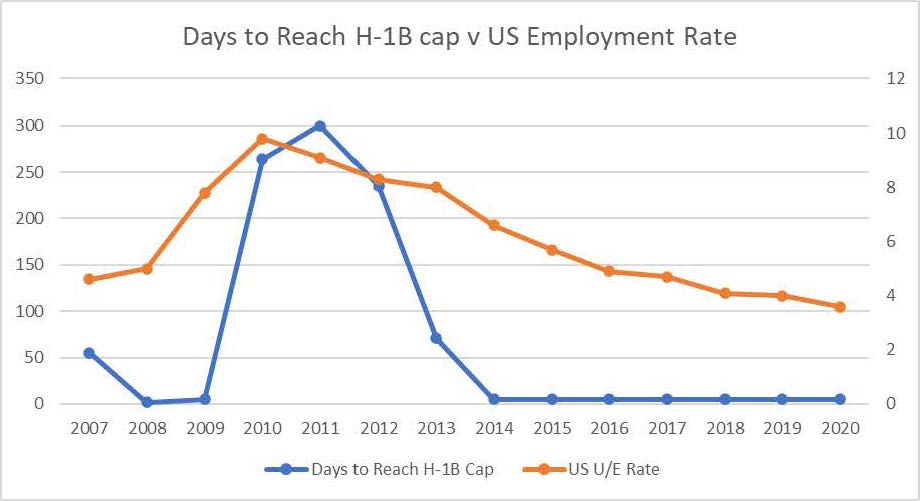
I run a version of this post every few years.  Here is the 2015 version.  The Economist liked that version of the post, replicating it here.   The data leads to the unimpeachable conclusion that the H-1B visa does not take away US workers jobs.  The H-1B visa fills jobs where it is nearly impossible to find qualified US workers.

In 2009, a mere 9,000 H-1Bs were received in the first month of H-1B processing.  It would be 264 days before the H-1B cap was reached. In 2010, it took 300 days until the H-1B cap was reached.  In 2011, there were 236 days between the April 1, 2011 cap opening and the November 23, 2011 cap being reached.  Not coincidentally, the US employment rate from 2009-2011 ranged between eight and ten percent.

On the other hand, the H-1B cap was reached on the very first day in 2007, 2008, 2013 and 2014, mirroring the low unemployment rate.


The lack of H-1B petition filings in years when the unemployment rate is high is compelling evidence against the argument that internationally-trained workers are being used to displace American workers and lower US workers' salaries.

Why?  Because if H-1B visa labor was being used primarily to lower US workers’ salaries, then H-1B filing numbers would not correlate with US unemployment rates.  If anything, the reverse would happen because the incentive to reduce workers’ salaries is likely greater in a recessed economy, not less.

The President and his hackneyed hatchet man Steven Miller do not believe in data.  The President recently signed a ridiculous Executive Order limiting permanent residency visas (green cards) for 60 days.  The Order accomplishes nothing, but may set the table for a broader visa ban, which could include H-1Bs and other temporary visas.

Miller recently said that "the most important thing is to turn off the faucet of new immigrant labor,” as if this will save American jobs.  It won’t.  Limiting immigrant labor has never saved a single American job and it never will. 

Miller is plainly not interested in the American economy.  He gave away his real interest when he said that the temporary ban would limit "chains of follow-on migration."  That is Miller’s real interest: stopping all forms of legal migration, which he believes waters down American culture.

This logic is straightforward.  Politicians should see employment visas for what they are -- tools for growing industries to fill labor shortages.  Organizations -- and governments -- work better when they work on data and not on nonsense and rhetoric.
 ____

Here is an updated version of the chart.  The most important part of the data looks at the spike in unemployment from 2008-2014.  The post-2014 data is less relevant.  It is worth nothing that since 2014 we have had record levels of H-1B petitions, and full employment.


Thursday, April 23, 2020

PRESIDENTIAL PROCLAMATION REGARDING TEMPORARY HAULT TO IMMIGRATION DUE TO COVID-19

President Trump has issued a Presidential Proclamation to temporarily stop the issuance of all immigrant visas (green cards) at Embassies abroad for sixty days effective midnight on April 23, 2020.  Contrary to the overarching language used in the President’s original tweet, the text of the Proclamation reveals that it will have very little impact on business immigration.

Importantly, this Proclamation does not apply to those who are already in the United States and applying for a green card, nor does it apply to those entering the US on a nonimmigrant visa, such as H-1B, TN, L-1, for F-1.  The Proclamation does not bar nonimmigrant visa extensions or transfers.

The Proclamation only applies to all those who are:
  • outside of the United States between April 23, 2020 – June 23, 2020; and
  • not in possession of either a valid immigrant visa or an official travel document, e.g. Advanced Parole; and
  • Not one of the categories of immigrants who are exempt from the Proclamation.  
Specific categories of those seeking to enter the US on an immigrant visa are exempt from Proclamation. The exempt groups are:

  • Permanent Residents of the US;
  • Healthcare workers and their immediate family members (including those family members traveling with the healthcare worker and those family members coming to the US at a later date);
  • Other individuals coming to the US to perform work essential to combating, recovering from, or alleviating the effects of Covid-19 and their immediate family members (including those family members traveling with the healthcare worker and those family members coming to the US at a later date). 
  • Spouses and children of US Citizens;
  • EB-5 investors;
  • Individuals who are entering to assist law enforcement or who are members of the US Armed Forces;
  • Special Immigrants in the SI or SQ Class and their family members; and
  • Any person whose entry is in the national interest of the US as determine by the Secretary of State or Secretary of Homeland Security.
The Proclamation may be extended beyond sixty days if President Trump deems it necessary to do so.  If you have questions about your application and whether you are exempt from the Proclamation, please contact your MU attorney.


Wednesday, March 18, 2020

USCIS TEMPORARILY SUSPENDS PREMIUM PROCESSING FOR FY2021 CAP-SUBJECT PETITIONS

The USCIS will temporarily suspend H-1B Cap petitioner’s ability to use the premium processing service. On or before May 27, 2020, USCIS will resume processing for cap-subject H-1B petitions who hold F-1 student nonimmigrant status.  This will allow F-1 students first priority at the premium processing service. 

USCIS will allow all other cap-subject H-1B petitions to use the premium processing service no later than June 29, 2020. 

Tuesday, February 25, 2020

DOS: NO EB-3 PROGRESSION UNTIL AT LEAST UNTIL MAY OR JUNE


The Department of State’s Visa Bulletin guru, Charlie Oppenheim, hosts monthly meetings with the American Immigration Lawyers Association.  Mr. Oppenheim is the Department of State’s Chief of the Control and Reporting Division. He is the officer who is responsible for producing the Visa Bulletin each month.

Charlie offered a number of interesting observations about the March Visa Bulletin, which resulted in a retrogression for EB-3.

-Because of the potential for USCIS to move resources to EB-1 and EB-2 and the unpredictability in processing times that will be caused by such a resource allocation, Charlie does not expect any forward movement to the EB-3.  The absolute earliest would be the May 2020 or June 2020 Visa Bulletin, but EB-3 could remain at January 2017 until the end of the fiscal year.  Charlie did assure readers that

-While it is expected that the implementation of the public charge rules may slow USCIS processing times, any potential slowdown at USCIS has not been factored into the March Visa Bulletin.

-DOS was not surprised that the retrogression happened in March, in spite of the January and February progression of dates in some EB-3 categories.  DOS wanted to wait until it was certain that the increase in demand was not showing any signs of decline.

Friday, February 21, 2020

STRATEGIES FOR DEALING WITH THE EB-3 RETROGRESSION


The March 2020 retrogression of EB-3 has significant consequences for those who are in the immigrant visa process.  It is expected that between March 1 and September 30 of this year, immigrant visas/green cards will only be issued to immigrants who have a 2016 priority date or earlier.  When the first bulletin of the next fiscal year is released in late September, we expect the Rest of World EB-3 to return to current and the Philippines EB-3 to have a roughly 18-24-month retrogression.  

Below are strategies for EB-3 immigrant applicants in various stages of the immigrant visa process:

Immigrants who will be adjusting status
USCIS has indicated that the dates for filing chart can be used in March. This means that the I-485 can only be filed if the immigrant has a priority date earlier than January 1, 2019.  This applies to both Filipino and Rest of World immigrant applicants. 

Immigrants currently at NVC phase with fee bill
If the applicant has already received fee bills, then the case can continue to be processed until the documentarily qualified notification is received from NVC.  An embassy interview will not be scheduled until the immigrant’s priority date is current under the final action chart which for March is January 1, 2017.  This applies to both Filipino and Rest of World immigrants.

Immigrants with approved I-140 but no fee bill
Immigrants should only receive the fee bill if the priority date is earlier than the date for filing of January 1, 2019, only we often see the NVC issue fee bills to those who have priority dates later than the dates of filing chart.  Those immigrants with 2019 and 2020 priority dates will receive a letter from NVC explaining that the case cannot move forward and a fee bill issued until the priority date is current under the date for filing chart.  Rest of World immigrants will continue to receive fee bills and be able to proceed through the NVC process but will not be able to receive an embassy interview until current under the final action chart.

Immigrants with embassy interviews scheduled for March
We expect these interviews will be rescheduled by the Embassy or Consulate until the priority date is current under the final action chart.

Thursday, February 20, 2020

WHAT DOES THE PHILIPPINE AND WORLDWIDE RETROGRESSION MEAN FOR EB-3 VISAS?


The March 2020 retrogression of the EB-3 category means that the US government has "overshot" their usage of visas in Fiscal Year 2020 (Oct 2019 - Sept 2020).  In order to remedy this, the government retrogresses the visas, which serves as a pause on the issuance of new visas.  The Philippine EB-3 date retrogressed because of increasing demand for Worldwide immigrant visas.  The Worldwide cut-off date can never be less favorable than any other country’s date.

This happens every few years.  Visa approvals will slow or stop starting in March, until the end of the fiscal year in September.  In October 2020, new allotment 140,000 visas are released into the system.  There is a chance that more visas are released into the system before the end of the Fiscal Year because, from time to time, the government's pause has its intended effect and more visas can be released before year-end.

If you are in any part of the visa process and you do not have your visa issued before March 1, 2020, your case will be held in abeyance at the Embassy or NVC, unless you have a priority date earlier than January 1, 2017 (Worldwide and Philippines). 

Tuesday, February 18, 2020

MARCH 2020 VISA BULLETIN: RETROGRESSION FOR EB3


The Department of State has just issued the March 2020 Visa Bulletin. This is the sixth Visa Bulletin of Fiscal Year 2020. This blog post analyzes this month's Visa Bulletin.

March 2020 Visa Bulletin

Table A: Final Action Dates -- Applications with these dates may be approved for their Green Card (Permanent Residency card) or Immigrant Visa appointment.

Employment-
based
All Other
CHINA
INDIA
PHILIPPINES
1st
01MAR19
01JUN17
01MAR15
01MAR19
2nd
C
15AUG15
22MAY09
C
3rd
01JAN17
22MAR16
15JAN09
01JAN17

MU Law Analysis

All Other: The All Other EB-1 had a four-month progression and the EB-2 category remained current.  Both should stay in their current ranges for the foreseeable future.  The EB-3 is retrogressed back to Jan 2017.  This retrogression occurred in all categories, except for China and India, where the retrogression is worse.  No forward movement is expected in EB3 for the rest of the fiscal year.  Demand in All Other EB-3 Adjustment of Status cases is responsible for the retrogression.

China: All Chinese EBs improved slightly.  Chinese EB-3 will not progress beyond the January 2017 retrogression date in all other EB-3 categories.

India:  There was virtually no progress for India.  We continue to expect very little progress in either category in future months.

Philippines:  The Philippine EB-3 number continues to confound.   We were encouraged by the three-month progression in EB-3 in February, only to be surprised by the retrogression back to January 2017.  Adding to the complexity is that virtually no Philippine EB-3s have been issued at Manila since the beginning of the year.

Thursday, February 13, 2020

H-1B CAP 2020: NEWS AND NOTES


The H-1B cap filing date will be here before you know it.  New H-1Bs are subject to the H-1B cap lottery and must be filed between March 1-20, 2020.  The USCIS will notify us of H-1B cap lottery winners by March 31, 2020.  If you are preparing to file an H-1B cap petition for 2020, please send MU the items on our checklist no later than March 10.

A variety of types of case are subject to H-1B cap:
-International students working on an EAD card under an OPT or CPT program after having attended a U.S. school;
-International employees working on a TN may need an H-1B filed for them  in order for them to pursue a permanent residency (green card) case;
-Prospective international employees in another visa status e.g. H-4, L-2, J-1, F-1; H-1B workers with a cap exempt organization; and
-Prospective international employees currently living abroad.

These types of case are not subject to H-1B cap:
-H-1B amendments/extensions/transfers
-When the employee has been in H-1B status for less than 6 years
-Trade Visas (H-1B1, E-3, TN-1) Chile, Singapore, Australia, Canada, Mexico
-Institution of higher education (or its affiliated or related nonprofit entities), a  nonprofit research organization, or a government research organization.

Please contact us if you have any questions or are looking for representation in filing H-1B cap petitions.

Thursday, January 23, 2020

REMINDER: NEW H-1B CAP REGISTRATION SYSTEM AND STRATEGIES FOR THE UPCOMING H-1B SEASON WEBINAR

MU Law will be hosting a free webinar for our clients and friends on Wednesday January 29, 2020 at 2PM / 11AM PT. Interested clients and friends can register for our webinar by clicking on the link below.

This webinar will discuss the NEW H-1B cap registration system and strategies for the upcoming H-1B season.

Webinar Agenda:

·   NEW H-1B Cap Registration System
·   H-1B Cap Projections
·   What is a Specialty Occupation?
·   H-1B Dependency
·   Special Issues for Staffing Companies and Third Party Placements
·   What is Third- Party Placement v. In-House work?
·   Employer-Employee relationships, how to maintain them
·   Cap-gap for F-1s as well as CPT/OPT maintenance -
·   Top 10 things H-1B employers can do to stay compliant
·   Q&A

PLEASE JOIN US!

Monday, January 20, 2020

FEBRUARY 2020 VISA BULLETIN: ANALYSIS AND PREDICTIONS

The Department of State has just issued the February 2020 Visa Bulletin. This is the fifth Visa Bulletin of Fiscal Year 2020. This blog post analyzes this month's Visa Bulletin. 

February 2020 Visa Bulletin

Table A: Final Action Dates -- Applications with these dates may be approved for their Green Card (Permanent Residency card) or Immigrant Visa appointment.

Employment-
based
All Other
CHINA
INDIA
PHILIPPINES
1st
15DEC18
22MAY17
01JAN15
01DEC18
2nd
C
01JUL15
19MAY09
C
3rd
C
01JAN16
08JAN09
01JUN18

MU Law Analysis

All Other: Although All Other EB-1 has a slight retrogression, the EB-2 category remained current and is expected to remain current for the foreseeable future.  The EB-3 is current, but the DOS expects to implement a retrogression in March.

China: EB-2 did not move, although EB-3 progressed by a month.  The EB-2 and EB-3 each progressed about one month.  Over the course of FY2020 we expect EB-2 and EB-3 to remain within a few months of each other.

India:  There was virtually no progress for India.  We continue to expect very little progress in either category in future months.

PhilippinesWe were encouraged by the three-month progression in EB-3.  We remain surprised by the slow progress of EB-3, although we were encouraged by this month’s progression.  We think that there is a chance of continued progression in the next few months, although the enactment of All Other EB-3 retrogression may mean that fewer visas are available for the Philippines.

Thursday, January 9, 2020

BUSINESS IMMIGRATION OUTLOOK FOR 2020


There are some obvious areas where we can expect to see activity in business immigration 2020.  Here are a few topics that we will keeping our eye on this year:

New H-1B Cap Process

The USCIS has confirmed that it will use an electronic pre-registration system for 2020 (Fiscal Year 2021).  Under this program, H-1B petitioners and beneficiaries must be registered between March 1-20, 2020.  Please join us for a teleconference on the new H-1B registration system to learn more.  REGISTER.

H-1B Specialty Occupation Rule

The USCIS recently published notice that it intends to revise the definition of specialty occupation, with an aim to restricting the number of people who qualify for the H-1B visa.  It remains to be seen what the revised definition says and whether or not the USCIS oversteps its authority with a new rule.  The USCIS continually is sued on these issues and usually settles the case by reopening and approving the H-1B petition. 

H-1B Employer-Employee Rule

Likewise, USCIS will also seek to revise the H-1B rule by creating a stricter law on who can be an H-1B employer.  USCIS’ own regulation says that its aim is to “to better protect U.S. workers and wages,” which has traditionally been the Department of Labor, not the USCIS’ role.  Again, we expect to see lawsuits if the USCIS exceeds the rules set forth by Congress.

Recession of the H-4 / EAD rule

The Trump Administration has, for years, sought to eliminate the H-4/EAD rule.  A recent USCIS court filing indicates that the rule rescinding work authorization could happen in March.

Tuesday, December 17, 2019

FAIRNESS FOR HIGH SKILLED IMMIGRANTS ACT COULD PASS SOON


The Fairness for High Skilled Immigrants Act has been a hot legislative item all year.  On several occasions, the bill has looked to be set into law, until a last minute Senate hold out has blocked the law’s progress.  One of the final holdouts, Sen. Durbin (D-IL), has just agreed to a compromise with Sen. Mike Lee (R-UT).  Sen. Lee is bill’s lead sponsor.

The bill, including Sen. Durbin’s amendments, would make these changes to Employment-Based Immigration:

Changes to the Green Card Quota and Process
  • Eliminate the per-country visa caps on employment-based workers over a three-year phase in period.  This will speed up processing Indian EB2 and EB3 retrogressed immigrants.
  • Allow all nonimmigrants in the US to file an I-485 Adjustment of Status 270 days (9 months) after the filing of their I-140, Petition for Alien Worker.  This will allow more job flexibility and protect Indian and Chinese H-1B and L-1 workers and their immediate families.  These Adjustment applicants must maintain qualifying employment and the entire family will retain their priority dates even if they would otherwise age-out.  This provides a great relief to long-retrogressed families.
  • There is a 4,400 visa carve-out for Schedule A workers.  As with current law, their immediate family members also take visas at the same time.  This provision will end in 2026.
  • There is also a second carve-out for non-Indian and Chinese nationals who have not worked in the US.  Our sense is that this will largely be used by non-H-1B occupations, such as Registered Nurses.  This provision ends in nine years.

 Changes to the H-1B visa
  • Employers with more than 50% H-1B / L-1 workers would be barred from the H-1B program.
  • H-1B Cap petitions must be posted on an on-line government job board prior to the filing of the H-1B cap petition.
  • Elimination of the B-1 in Lieu of H-1B business visa rule.
  • Additional wage protection for H-1B workers.
  • Additional protections for H-1B whistleblowers. 

Next Steps
Sen. Lee is expected to try to pass the bill in the Senate this week, perhaps as soon as today.  The bill will need to go back to the House of Representatives, where it is expected to pass, perhaps before the end of the year.  After that the President will need to sign the Bill into law, which is expected.