Showing posts with label green card; NIV. Show all posts

Monday, July 20, 2020

AUGUST 2020 VISA BULLETIN: EB3 JUMPS ONE FULL YEAR


The Department of State has just issued the August 2020 Visa Bulletin. This is the eleventh Visa Bulletin of Fiscal Year 2020. This blog post analyzes this month's Visa Bulletin.

August 2020 Visa Bulletin

Table A: Final Action Dates -- Applications with these dates may be approved for their Green Card (Permanent Residency card) or Immigrant Visa appointment.

Employment-
based
All Other
CHINA
INDIA
PHILIPPINES
1st
C
08FEB18
08FEB18
C
2nd
C
15JAN16
08JUL09
C
3rd
01APR19
15FEB17
01OCT09
01APR19

MU Law Analysis

This Visa Bulletin continued the big progressions that we saw in the June and July Visa Bulletins.  MU Law has been calling on the DOS to rapidly advance the dates so that all immigrant visas are used in 2020, and they finally responded in a big way.  The big story is the one-year progression Worldwide EB-3 and Philippines EB-3.  These EB-3 dates are now at April 2019.

The good news was not limited to those categories.  India EB-1 and India EB-3 also jumped forward.  EB-1 moved ahead ten months to February 2018, and EB-3 by five months, to October 2009.  Only India EB-2 disappointed, staying at July 8, 2009.  India EB-2 and EB-3 are inverted.  MU Law expects India EB-2 and EB-3 to move in sync for the foreseeable future.  EB-2s will downgrade their petitions to EB-3 to take advantage of the more favorable processing date, leading to an equilibrium between the two categories. 

All of the China categories moved forward as well, as expected in a year where few immigrant visa have been issued. 

MU Law expects the favorable employment-based visa dates to continue next fiscal year.  We explained why on this blog post.

Tuesday, June 23, 2020

TRUMP ISSUES WIDE RANGING EXECUTIVE ORDER BANNING NEW LEGAL EMPLOYMENT BASED IMMIGRANTS UNTIL 2021

Last night, President Trump updated and expanded his April Presidential Proclamation that had banned legal immigrant visas for 60 days.  Last night’s ban extends the April legal immigration ban through December 31, 2020 and adds many temporary employment-based nonimmigrant visas, including H-1Bs, L-1s, J-1s, and H-2Bs. 

It seems certain that the President will be sued and so any information contained here is subject to the outcome of the lawsuits.

The ban effects many types of employment-based immigration, such as:

Green Cards (Immigrant visas) Consular Processing

All Consular Processing green cards continue to be banned, as they have been since April.  There are a few exceptions:
  • Permanent Residents of the US;
  • Healthcare workers and their immediate family members (including those family members traveling with the healthcare worker and those family members coming to the US at a later date);
  • Other individuals coming to the US to perform work essential to combating, recovering from, or alleviating the effects of Covid-19 and their immediate family members (including those family members traveling with the healthcare worker and those family members coming to the US at a later date).
  • Spouses and children of US Citizens;
  • EB-5 investors;
  • Individuals who are entering to assist law enforcement or who are members of the US Armed Forces;
  • Special Immigrants in the SI or SQ Class and their family members; and
  • Any person whose entry is in the national interest of the US as determine by the Secretary of State or Secretary of Homeland Security.

Green Cards (Immigrant visas) Adjustment of Status

No effect whatsoever.  Many Adjustment of Status interviews, of course, have been delayed because of COVID-19, although we have seen that the USCIS is approving some employment based green cards without an actual visa interview.

H-1B, L-1, J-1, and H-2B visas

  • Beneficiaries approved for H-1B and L-1s will not be allowed to enter the US unless they currently have a valid visa stamp, even if they have an approved I-797.
  • H-1B and L-1 visa stamps cannot be granted at embassies or consulates unless the H-1B or L-1 is for one of the exemption categories below. 
  • If you have an H-1B or L-1 approval and you are in the US, you should not travel outside the US unless you already have a valid H-1B visa stamp in your passport and you intend to return to the US prior to the expiration of that visa stamp.
  • H-1B and L-1 amendments, extensions, and transfers continue to be permissible.
  • H-1B cap petitions that are based on a change of status (e.g. F-1 to H-1B) should be approved with a new I-94 card for the H-1B status.  The ban does not prohibit or effect the change of status, however, individuals changing status to H-1B should not leave the US after October 1 as they will not be able to return without a valid H-1B visa stamp.  
  • Similar prohibitions apply to J-1 and H-2B visas, although the J-1 visa ban is limited to interns, trainees, teachers, camp counselors, au pairs, and summer work programs.  Other J-1s may obtain visas and enter the US.
  • The ban also applies to the H-4, L-2, J-2 dependent classifications.  Spouses and children in the US as dependents should not travel abroad unless each family member has a valid visa stamp in their passport.  Dependents who are currently abroad will not be allowed to enter the US unless they currently have a valid visa stamp.

 Exemptions to the H-1B, L-1, J-1, and H-2B nonimmigrant visa ban

The visa ban does not apply to:
  • any lawful permanent resident of the United States;
  • any alien who is the spouse or child of a United States citizen;
  • any alien seeking to enter the United States to provide temporary labor or services essential to the United States food supply chain; and
  • any alien whose entry would be in the national interest as determined by the Secretary of State or the Secretary of Homeland Security.

National Interest Entry Requests

The Proclamation allows for exemptions to the nonimmigrant visa ban if the Beneficiary is one of several categories deemed by DOS or DHS to be “in the national interest”.  It is expected that the DOS and DHS will issue details about these exemptions and the process to request an exemption.  The Proclamation’s named categories include those who:
  •  are critical to the defense, law enforcement, diplomacy, or national security of the United States;
  • are involved with the provision of medical care to individuals who have contracted COVID-19 and are currently hospitalized;
  • are involved with the provision of medical research at United States facilities to help the United States combat COVID-19;
  • are necessary to facilitate the immediate and continued economic recovery of the United States; or
  • are children who would age out of eligibility for a visa as a result of the visa ban.

Friday, June 19, 2020

EMPLOYMENT BASED IV QUOTA COULD INCREASE BY 60,000 IN FY 2021


The Department of State expects that there will be “significant advancement” in many categories, including all EB-1s and EB-5s, as well as EB-3 Worldwide and Philippines, starting in FY 2021 (October 2020 Visa Bulletin). This is terrific news for all EB IV applicants.

The news come from the Department of State’s Charlie Oppenhiem, who is always gracious with his time.  Charlie’s monthly AILA Q&As, Check In With Charlie, are always informative.  This month’s Check In contained many interesting answers, including answers to questions posed by MU attorneys.

Charlie expects that the Family-Based Immigrant Visa category will be underused by about 60,000 visas, as a result of slowdowns in processing related to COVID-19.  US law says that when the FB IV does not meet its quota, all of those visa flow into the Employment-Based category in the next fiscal year.  Therefore, Charlie expects the EB category to increase from 140,000 to about 200,000 visas in FY 2021. 

This means that the per country quotas, which are normally about 10,000 IVs, will increase to approximately 14,000 IVs per country.  It is this increase in EB visas that will lead to the dramatic progressions in October 2020.

Charlie also helpfully explained that while he could have progressed the Visa Bulletin more aggressively in June and July, he did not do so because “processing capacity at both consular posts and USCIS is diminished due to the pandemic.”  Therefore, Visa Bulletin progressions would not have meant increased visa umber usage and may have resulted in a future retrogression, which he tries to avoid.


Tuesday, June 16, 2020

JULY 2020 VISA BULLETIN: PROGRESS FOR PHILS AND WW EB-3

The Department of State has just issued the July 2020 Visa Bulletin. This is the tenth Visa Bulletin of Fiscal Year 2020. This blog post analyzes this month's Visa Bulletin.

July 2020 Visa Bulletin

Table A: Final Action Dates -- Applications with these dates may be approved for their Green Card (Permanent Residency card) or Immigrant Visa appointment.

Employment-
based
All Other
CHINA
INDIA
PHILIPPINES
1st
C
22AUG17
08MAY17
C
2nd
C
08NOV15
08JUL09
C
3rd
15APR18
22JUN16
01JUN09
15APR18

MU Law Analysis

This Visa Bulletin continued the big progressions that we saw in the June Visa Bulletin.  MU Law has been calling on the DOS to rapidly advance the dates so that all immigrant visas are used in 2020.  Many visas appear that they will go unused without this progression. 

The Worldwide EB-3 dates moved almost six months are now at April 2018, as is the Philippines EB-3.  We continue to expect big progressions in these categories for the August and September VBs because very few visas were used due to the global shutdown caused by COVID-19.

The Indian EB-3 dates moved ahead two months.  It continues to move at a quicker rate than we have seen in years.  India EB-2 even advanced a month.  China EB-2 and EB-3 advanced by one week.  We might see continued progressions of a few weeks or months in these categories for the rest of the fiscal year.

The EB-1 movements were also reassuring.  As was the case last month, India EB-1 progressed another 10 months, reflecting reduced demand.  China EB-1 advanced by a week, as the DOS remains concerned about pending demand.  Limited progressions in EB-1 and EB-2 categories in the future could mean that more visa numbers flow down to EB-3, which would mean more advancement.

Thursday, May 21, 2020

JUNE 2020 VISA BULLETIN: PROGRESS FOR PHILS AND WW EB-3; EB-1


The Department of State has just issued the June 2020 Visa Bulletin. This is the ninth Visa Bulletin of Fiscal Year 2020. This blog post analyzes this month's Visa Bulletin.

June 2020 Visa Bulletin

Table A: Final Action Dates -- Applications with these dates may be approved for their Green Card (Permanent Residency card) or Immigrant Visa appointment.

Employment-
based
All Other
CHINA
INDIA
PHILIPPINES
1st
C
15AUG17
08JUN16
C
2nd
C
01NOV15
12JUN09
C
3rd
08NOV17
15JUN16
01APR09
08NOV17

MU Law Analysis

This was another eagerly anticipated Visa Bulletin.  The DOS moved the Philippines and Worldwide EB-3 ahead by 10 months, which is encouraging.  The Indian and Chinese EB-3 dates moved ahead one month, which is also a promising sign. It would not surprise us to see another big progression in the July Visa Bulletin, especially for the Philippines and Worldwide EB-3s. 

The EB-1 movements were also reassuring.  India EB-1 progressed 10 months.  China EB-1 advanced by a month.  The Indian and Chinese EB-2 dates also moved ahead, with India progressing by 10 days and China by one month.  These progressions could mean that more visa numbers flow down to other categories.

MU continues to believe that the State Department should be accelerating these dates at a faster rate and will need to aggressively accelerate the dates in the next few months in order to ensure that all visas are used in fiscal year 2020.  We have said this for several months.  Very few immigrant visas have been issued in the last 60 days because of the COVID-19 crisis. 

Conspiracy rumors are out there.  Some are speculating that the White House is interfering and illegally holding back progressions. The State Department did not include any comments at the end of the Visa Bulletin.  This lack of transparency from the State Department is feeding the speculation.  At the very least the State Department should explain how it expect to use this year’s full allotment of immigrant visas.

Wednesday, April 29, 2020

SAY IT AGAIN: THE H-1B DOES NOT TAKE AWAY US WORKERS JOBS

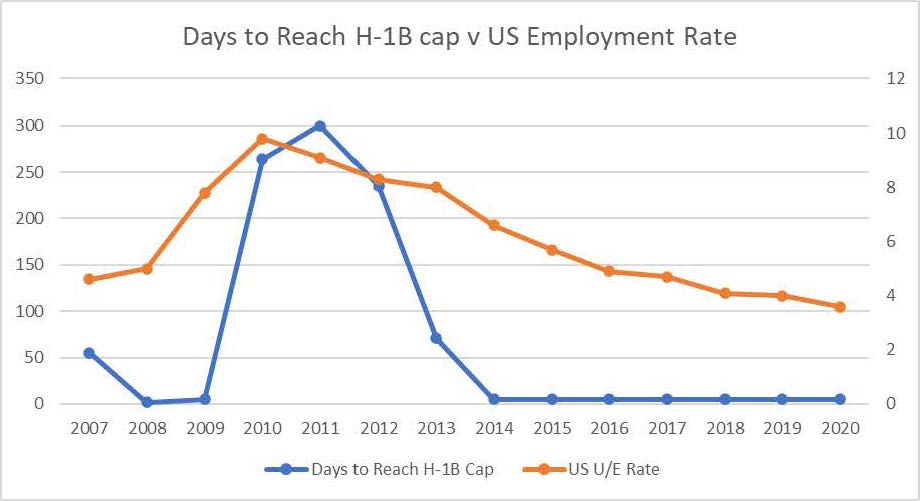
I run a version of this post every few years.  Here is the 2015 version.  The Economist liked that version of the post, replicating it here.   The data leads to the unimpeachable conclusion that the H-1B visa does not take away US workers jobs.  The H-1B visa fills jobs where it is nearly impossible to find qualified US workers.

In 2009, a mere 9,000 H-1Bs were received in the first month of H-1B processing.  It would be 264 days before the H-1B cap was reached. In 2010, it took 300 days until the H-1B cap was reached.  In 2011, there were 236 days between the April 1, 2011 cap opening and the November 23, 2011 cap being reached.  Not coincidentally, the US employment rate from 2009-2011 ranged between eight and ten percent.

On the other hand, the H-1B cap was reached on the very first day in 2007, 2008, 2013 and 2014, mirroring the low unemployment rate.


The lack of H-1B petition filings in years when the unemployment rate is high is compelling evidence against the argument that internationally-trained workers are being used to displace American workers and lower US workers' salaries.

Why?  Because if H-1B visa labor was being used primarily to lower US workers’ salaries, then H-1B filing numbers would not correlate with US unemployment rates.  If anything, the reverse would happen because the incentive to reduce workers’ salaries is likely greater in a recessed economy, not less.

The President and his hackneyed hatchet man Steven Miller do not believe in data.  The President recently signed a ridiculous Executive Order limiting permanent residency visas (green cards) for 60 days.  The Order accomplishes nothing, but may set the table for a broader visa ban, which could include H-1Bs and other temporary visas.

Miller recently said that "the most important thing is to turn off the faucet of new immigrant labor,” as if this will save American jobs.  It won’t.  Limiting immigrant labor has never saved a single American job and it never will. 

Miller is plainly not interested in the American economy.  He gave away his real interest when he said that the temporary ban would limit "chains of follow-on migration."  That is Miller’s real interest: stopping all forms of legal migration, which he believes waters down American culture.

This logic is straightforward.  Politicians should see employment visas for what they are -- tools for growing industries to fill labor shortages.  Organizations -- and governments -- work better when they work on data and not on nonsense and rhetoric.
 ____

Here is an updated version of the chart.  The most important part of the data looks at the spike in unemployment from 2008-2014.  The post-2014 data is less relevant.  It is worth nothing that since 2014 we have had record levels of H-1B petitions, and full employment.


Wednesday, February 5, 2020

TRAVEL BAN 4.0

On January 31, 2020, the President issued a Presidential Proclamation expanding the existing travel ban to include the following countries: Burma (Myanmar), Eritrea, Kyrgyzstan, Nigeria, Sudan, and Tanzania. 

The new travel ban goes into effect February 21, 2020 at midnight.  Individuals from countries on the new travel ban who have received their visas before February 21, 2020 can still enter the US. However, we recommend that individuals from the newly banned countries enter before the travel ban goes into effect on February 21, 2020.

The government will be reviewing the banned countries on October 1, 2020, and annually thereafter. If the banned countries comply with the US on information sharing, the country may be removed from the banned list. 

The full travel ban now includes the following thirteen countries and different types of visas are banned for each country:

Eritrea
Suspends the entry of immigrants, except as Special Immigrants who have provided assistance to the U.S. government.
Kyrgyzstan
Suspends the entry of immigrants, except Special Immigrants who have provided assistance to the U.S. government.
Iran
Suspends the entry of immigrants and all nonimmigrants, except F (student), M (vocational student) and J (exchange visitor) visas, though they are subject to enhanced screening.
Libya
Suspends the entry of immigrants and temporary visitors on business or tourist visas (B-1/B-2).
Myanmar
Suspends the entry of immigrants, except Special Immigrants who have provided assistance to the U.S. government.
Nigeria
Suspends the entry of immigrants, except Special Immigrants who have provided assistance to the U.S. government.
North Korea
Suspends the entry of all immigrants and nonimmigrants.
Somalia
Suspends the entry of immigrants and requires enhanced screening of all nonimmigrants.
Sudan
Suspends the entry of Diversity Visa immigrants
Syria
Suspends the entry of all immigrants and nonimmigrants.
Tanzania
Suspends the entry of Diversity Visa immigrants
Venezuela
Suspends the entry of certain government officials and their family members on business or tourist visas (B-1/B-2).
Yemen
Suspends the entry of immigrants and temporary visitors on business or tourist visas (B-1/B-2).


Citizens of the banned countries who are already present in the United States can file for extensions of status, changes of status, or for green cards (adjustment of status). 

If you are a citizen of one of the banned countries, please reach out to your MU attorney for further guidance. 

Monday, February 3, 2020

US DEPARTMENT OF HOMELAND SECURITY IMPLEMENTS NEW “PUBLIC CHARGE” RULE


On August 14, 2019 the Department of Homeland Security (DHS) announced a new “public charge” rule.  The rule was set to into effect on October 15, 2019, but was stopped by a nationwide injunction.  On January 27, 2020 the US Supreme Court lifted the nationwide injunction.  Note that an injunction still remains in effect in Illinois.  On February 24, 2020 the new public charge rule will go into effect.

Under a longstanding law and policy, if immigration authorities determine someone is “likely to become a public charge” the US can deny the applicant’s green card or other visa to the US.  A public charge is someone who is dependent on the government, through benefits programs.  The Trump Administration’s new rule changes the standard by the DHS determines whether a foreign national is likely to become a public charge.

Under the previous policy, DHS examined whether an intending immigrant was primarily dependent on public benefits.  Under the new rule, immigration officers will examine whether immigrants are likely at any time to become a public charge, using a multi-factor test. 

Public benefits under the new rule include:
1)   Any federal, state, or local cash assistance, including:
a.    Social Security Income (SSI)
b.    Temporary Assistance for Needy Families (TANF)
c.    Government programs for income maintenance often called “general assistance”
2)   Supplemental Nutrition Assistance Program (SNAP) also known as food stamps
3)   Section 8 Housing Assistance
4)   Medicaid, with certain exceptions
5)   Public Housing under Section 9

The immigration officer will take into account a broad range of factors and consider all of the following when making a determination if the foreign national visa applicant is likely to become a pubic charge:
a.    Receipt of a public benefit for more than 12 months in the aggregate within a 36 month period
b.    Age
c.    Health
d.    Family status
e.    Education and skills
f.     Assets, resources, and financial status

This rule will apply to all applicants for any type of visa, though it is expected that the immigration officers will look most closely at those applying for a green card.  Employment-based visa applicants should be treated favorably because, by virtue of their employer-sponsor, they have guaranteed employment and income in the United States.  However, policy experts forecast that this rule will likely be applied inconsistently and cause fewer legal immigrants to enter the United States. 

Thursday, January 23, 2020

REMINDER: NEW H-1B CAP REGISTRATION SYSTEM AND STRATEGIES FOR THE UPCOMING H-1B SEASON WEBINAR

MU Law will be hosting a free webinar for our clients and friends on Wednesday January 29, 2020 at 2PM / 11AM PT. Interested clients and friends can register for our webinar by clicking on the link below.

This webinar will discuss the NEW H-1B cap registration system and strategies for the upcoming H-1B season.

Webinar Agenda:

·   NEW H-1B Cap Registration System
·   H-1B Cap Projections
·   What is a Specialty Occupation?
·   H-1B Dependency
·   Special Issues for Staffing Companies and Third Party Placements
·   What is Third- Party Placement v. In-House work?
·   Employer-Employee relationships, how to maintain them
·   Cap-gap for F-1s as well as CPT/OPT maintenance -
·   Top 10 things H-1B employers can do to stay compliant
·   Q&A

PLEASE JOIN US!

Tuesday, December 3, 2019

PWDs WILL CONTINUE TO TAKE 4 MONTHS (AND OTHER NOTES FROM DOL)

On November 5, 2019 the Department of Labor held a presentation and gave updates to a number of their programs.  AILA has reported on the update.  The updates include:

-DOL expects that PWD processing times will remain at 4 months, despite its goal to get the processing time down to 90 days.

-The Form 9141 (PWD) has been updated and posted to the OMB webpage.  The expectation is that it will go live in mid-2020. Until that time, the current Form 9141 remains valid, even though it lists an expired 10/31/2019 date.

-With the October launch of LCAs on the PERM system, iCert will soon be decommissioned.

-At some point PERM will move to the FLAG system, although it is not expected until 2021 at the earliest.

Wednesday, November 20, 2019

DECEMBER 2019 VISA BULLETIN: ANALYSIS AND PREDICTIONS


The Department of State has just issued the December 2019 Visa Bulletin. This is the third Visa Bulletin of Fiscal Year 2020. This blog post analyzes this month's Visa Bulletin. 

December 2019 Visa Bulletin

Table A: Final Action Dates -- Applications with these dates may be approved for their Green Card (Permanent Residency card) or Immigrant Visa appointment.

Employment-
based
All Other
CHINA
INDIA
PHILIPPINES
1st
15JUN18
15MAY17
01JAN15
01JUN18
2nd
C
22JUN15
15MAY09
C
3rd
C
01NOV15
01JAN09
01MAR18


MU Law Analysis

All Other: Although All Other EB-1 has a slight retrogression, the EB-2 and EB-3 categories remained current and are expected to remain current for the foreseeable future.

China: EB-2 did progress by three months.  The EB-2 and EB-3 remain inverted, in spite of the fact that China EB-3 did not progress at all.  Over the course of FY2020 we expect EB-2 to catch up to EB-3 and the two categories to stay roughly   equal. 

India: As with China, the EB-2 and EB-3 dates remain inverted.  There was no material progress in either category.  We expect very little progress in either category in future months.

Philippines:  We remain surprised by the slow progress of EB-3.  The DOS indicated that demand for Adjust of Status cases is tamping down the promotion of dates.  Of course, Philippines EB-3 uses much less Adjust of Status visas than other categories, which makes this explanation suspect.  We still find the EB-3 priority date to be too conservative, but at this point we are no longer predicting as rosy progressions in early 2020.